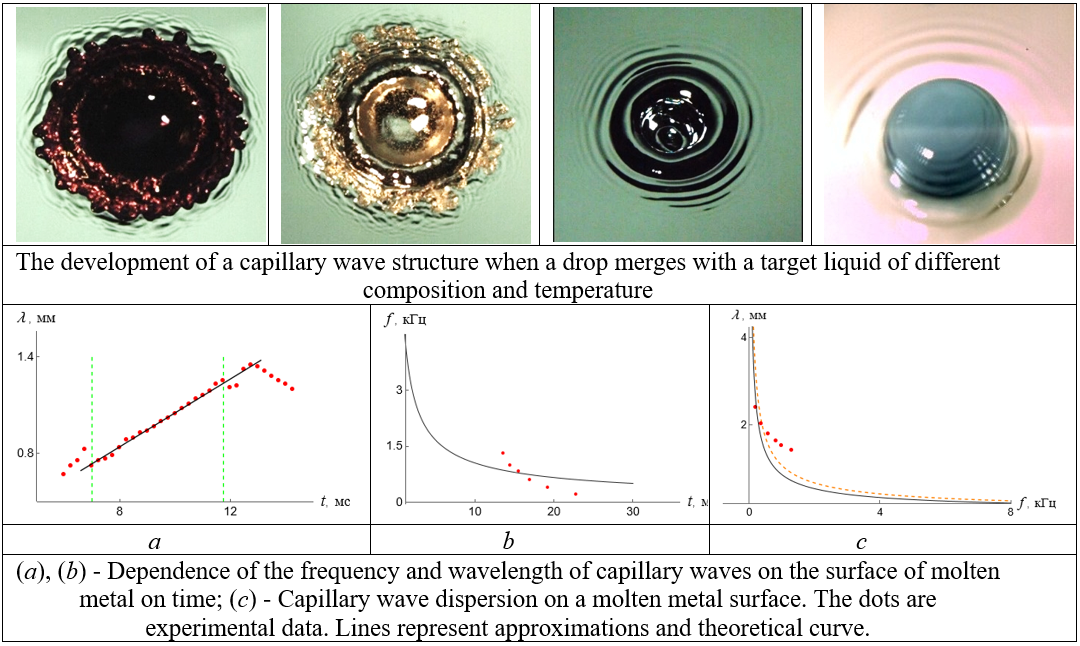
Dispersion of capillary waves in various liquids during the coalescence of a falling drop in the impact mode
In a series of experiments with a high-speed camera, the evolution of capillary waves excited by the fall of a water drop onto the surface of a molten metal at room and high temperatures was investigated. Based on images obtained in experiments with a high-speed camera, a dispersion relation is constructed for capillary waves on the surface of molten metal and water induced by the merging of a falling drop with the surface of the target liquid. Using spectral analysis and direct measurement methods, approximations of the dependence of the wavelength and frequency of capillary waves on time are first constructed using power functions. Then, the "frequency-wavelength" points are extracted from these dependencies, which are also approximated by a power function. The quality of the selected power dependence is assessed by the degree of closeness of the approximating curve to the theoretical one, as well as by the magnitude of the relative deviation of the experimental power factor from the theoretical one. A qualitative and quantitative comparison of experiments with water and molten metal is performed.
capillary waves, drop impact, experiment, wave dispersion
В рамках серии экспериментов со скоростной камерой исследована эволюция капиллярных волн, возбуждаемых падением капли воды на поверхность расплава металла при комнатной и высокой температурах. На основе полученных в экспериментах изображений построено дисперсионное соотношение для капиллярных волн на поверхности расплава металла и воды. Используя методы спектрального анализа и прямых измерений, с помощью степенных функций сначала строятся аппроксимации зависимости длины волны и частоты капиллярных волн от времени. Затем из этих зависимостей извлекаются точки «частота-длина волны», которые также аппроксимируются степенной функцией. Качество подобранной степенной зависимости оценивается по степени близости аппроксимирующей кривой к теоретической, а также по величине относительного отклонения экспериментального степенного множителя от предсказанного теорией. Выполнено качественное и количественное сравнение опытов с водой и расплавленным металлом.
1. Chashechkin Y. D., Foundations of engineering mathematics applied for fluid flows // Axioms. 2021, vol. 10, no. 4, p. 286. https://doi.org/10.3390/axioms10040286. 2. Чашечкин Ю. Д., Очиров А. А., Лапшина К. Ю. Поверхностные волны вдоль границы раздела устойчиво стратифицированных жидких сред//Физико-химическая кинетика в газовой динамике. 2022. Т.23, вып. 6. http://chemphys.edu.ru/issues/2022-23-6/articles/1028/ 3. Wout M. Goesaert, Paul S. W. M. Logman; Easy method to establish the dispersion relation of capillary waves on water jets. Am. J. Phys. 1 February 2024; 92 (2): 93–99. https://doi.org/10.1119/5.0144849 4. Чашечкин Ю.Д., Прохоров В.Е. Гидродинамика удара капли: короткие волны на поверхности венца. Докл. РАН, 2013, т. 451, № 1, с. 41–45. https://doi.org/10.7868/s0869565213190109 5. Иванцов А. О., Любимова Т. П., Воробьев А. М. Численное моделирование эволюции гравитационных и капиллярных волн в системе двух слабосмешивающихся жидкостей // Материалы международного симпозиума «Неравновесные процессы в сплошных средах», Том 1, 2017, С. 194-197. https://elibrary.ru/item.asp?id=32178104 6. Van der Eijk, M., & Wellens, P. R. (2020). A compressible two-phase flow model for pressure oscillations in air entrapments following green water impact events on ships. International Shipbuilding Progress, 1–29. doi:10.3233/isp-200278 7. Tan, M. K., Friend, J. R., Matar, O. K., & Yeo, L. Y. (2010). Capillary wave motion excited by high frequency surface acoustic waves. Physics of Fluids, 22(11), 112112. doi:10.1063/1.3505044 8. Zhang S, Orosco J, Friend J. Onset of Visible Capillary Waves from High-Frequency Acoustic Excitation. Langmuir. 2023 Mar 14;39(10):3699-3709. doi: 10.1021/acs.langmuir.2c03403. Epub (2023) Mar 1. PMID: 36857201; PMCID: PMC10018762. 9. Brekke, C. and Solberg, A. (2005) Oil Spill Detection by Satellite Remote Sensing. Remote Sensing of Environment, 95, 1-13. http://dx.doi.org/10.1016/j.rse.2004.11.015 10. Naeser, H. The Capillary Waves’ Contribution to Wind-Wave Generation. Fluids 2022, 7, 73. https://doi.org/10.3390/fluids7020073 11. Yang, Z., Ji, B., Ault, J.T. et al. Enhanced singular jet formation in oil-coated bubble bursting. Nat. Phys. 19, 884–890 (2023). https://doi.org/10.1038/s41567-023-01958-z 12. Alvarez, M., Friend, J., & Yeo, L. Y. (2008). Rapid generation of protein aerosols and nanoparticles via surface acoustic wave atomization. Nanotechnology, 19(45), 455103. doi:10.1088/0957-4484/19/45/455103 13. Orme, B., Torun, H., Unthank, M. et al. Capillary wave tweezer. Sci Rep 14, 12448 (2024). https://doi.org/10.1038/s41598-024-63154-0 14. Уизем Дж. Линейные и нелинейные волны: Пер. с англ. М.: Мир, 1977, 621 с. 15. Лэмб Г. Гидродинамика. М.; Л.: Гостехиздат 1947 – 928 с. 16. УИУ “ГФК ИПМех РАН”: Гидрофизический комплекс для моделирования гидродинамических процессов в окружающей среде и их воздействия на подводные технические объекты, а также распространения примесей в океане и атмосфере. Сайт: http://www.ipmnet.ru/uniqequip/gfk/#equip. 17. Handschuh-Wang S, Chen Y, Zhu L, Zhou X. Analysis and transformations of room-temperature liquid metal interfaces - A closer look through interfacial tension. Chemphyschem. 2018 Jul 5;19(13):1584-1592. doi: 10.1002/cphc.201800129. Epub 2018 Apr 17. PMID: 29539243. 18. Хайирбеков Ш. Х. Подавление шумов и фильтрация при обработке изображений капельных и волновых течений. //Физико-химическая кинетика в газовой динамике. 2024. Т.25, вып. 2. http://chemphys.edu.ru/issues/2024-25-2/articles/1095/