Investigation of the oscillatory process of the TiH2 thermal decomposition using the lotka’s model
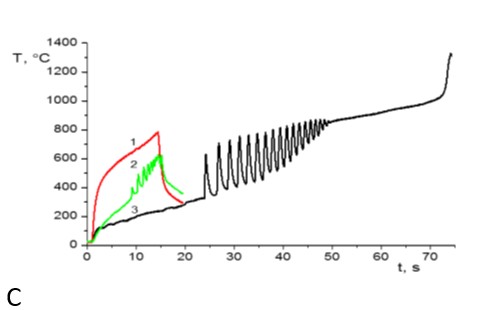
Numerical simulation of oscillatory processes of thermal decomposition of titanium hydride in a cylindrical reactor using Lotka’s kinetics a kinetic tray scheme has been carried out. The occurrence of fluctuations in the temperature of hydrogen and the densities of hydrogen, tita-nium, and titanium hydride is possible with a sufficiently high heat flux of an exothermic re-action of the Lotkay type. The system of governing equations consists of the conservation of mass of components and thermal balance includes as well a finite diffusion rate along with the kinetics of Lotka generalized to the case of reversible decomposition and reduction reac-tions of titanium hydride. The dependence of the amplitude of temperature fluctuations of the gas component on the initial density of titanium hydride and the heating method from an ex-ternal source is investigated. Temperature fluctuations have a damping character and are a followed by by a decreasing stage , or by the formation of an equilibrium temperature value depending on heat exchange with the external environment. The modes of temperature in-crease at the end of fluctuations during non-stationary heating are noted. The results of tem-perature calculation are in satisfactory agreement with experimental data [8]. The dynamics of fluctuations in the density of the components of the gas and solid phases is given.
thermal decomposition of titanium hydride; hydrogen storage; model of TiH2 decay and re-duction kinetics.
Проведено численное моделирование колебательных процессов термической декомпо-зиции гидрида титана в цилиндрическом реакторе с применением кинетической схемы Лотки. Возникновение колебаний температуры водорода и плотностей водорода, тита-на и гидрида титана возможно при достаточно высоком тепловом потоке от внешнего источника Система определяющих уравнений сохранения массы компонент и тепло-вого баланса включает конечную скорость диффузии наряду с кинетикой Лотки, обобщенной на случай обратимых реакций декомпозиции и восстановления гидрида титана. Исследована зависимость амплитуды колебаний температуры газовой компо-ненты от начальной плотности гидрида титана и способа нагрева от внешнего источ-ника. Колебания температуры имеют затухающий характер и сменяются понижением температуры, либо формированием равновесного значения температуры в зависимости от теплообмена с внешней средой. Отмечены режимы роста температуры по оконча-нию колебаний при нестационарном нагреве. Результаты вычисления температуры удовлетворительно согласуются с экспериментальными данными [8]. Приводится ди-намика колебаний плотности компонент газовой и твердой фаз.
термическая декомпозиция гидрида титана; хранение водорода; модель кинетики рас-пада и восстановления TiH2.
Литература 1. A.J. Lotka, “Contribution to the theory of periodic reactions.” J. Phys. Chem. 14, 271 (1910). 2. Корзухин М. Д., Жаботинский А. М. Математическое моделирование химических и эколо-гических автоколебательных систем. — М.: Наука, 1965 3. Куркина Е. С., Макеев А. Г. Математическое моделирование колебаний в химической ре-акции типа Лотки, происходящей на поверхности катализатора //Прикладная математика и информатика: Труды факультета ВМК МГУ. М.: МАКС Пресс. – 2011. – №. 39. – С. 70-99. 4. Е. Д. Куретова, Е. С. Куркина, “Общая математическая модель химической реакции, про-текающей в слое зернистого катализатора”, Ж. вычисл. матем. и матем. физ., 42:7 (2002), 1080–1093 5. Е. С. Куркина, С. M. Макарова, М. М. Слинько, “Математическое моделирование автоко-лебаний скорости реакций окисления окиси углерода на металлических катализаторах”, Матем. моделирование, 2:1 (1990), 14–26 6. Shkadinskii, K.G., Khaikin, B.I., and Merzhanov, A.G. Propagation of a pulsating exothermic re-action front in the condensed phase, Combust. Explos. Shock Waves, 1971, no. 7, pp. 15–22. https://doi.org/10.1007/BF00748907 7. А. П. Пурмаль. Простая кинетика сложных реакций. Moscow:MFTI, 2011, pp. 80–85. 8. S. G. Vadchenko, A. S. Rogachev. Evidence of an Oscillating Reaction during Heating of TiH2 in Air. Int. Journal of Self-Propagating High-Temperature Synthesis, 2024, Vol. 33, No. 3, pp. 245–248. DOI: 10.3103/S1061386224700213 9. Л. В. Спивак. Три стадии термической декомпозиции гидрида титана в среде с низким парциальным давлением водорода. // Вестник Пермского университета. Серия: Физика. Вып. 3 2015 с. 13–21. 10. Khokhonov, A.A., Shaikhatdinov, F.A., Bobrovskii, V.A., Agarkov, D.A., Bredikhin, S.I., Chichirov, A.A., and Rybina, E.O., Hydrogen storage technologies. Hydrogen energy stores, Uspekhi Khim. Khim. Tekhnol., 2020, vol. 34, no. 12, pp. 47–52. 11. Gromov, A.R., Kouznetsova, N.N., Yudina, S.L., and Lunin, V.V., The investigation of titanium hydride oxidation process, J. Alloys Compd., 1997, vol. 261, nos. 1–2, pp. 269–272. https://doi.org/10.1016/S0925-8388(97)00193-X 12. Young, G., Jian, G., Jacob, R., and Zachariah, M.R., Decomposition and ignition characteristics of titanium hydride at high heating rates, Combust. Sci. Technol., 2015, vol. 187, pp. 1182–1194. https://doi.org/10.1080/00102202.2015.1019619 13. Kaciulis, S., Soltani, P., Mezzi, A., Montanari, R., Lapi, G., Richetta, M., Varone, A., and Barbi-eri, G., Oxidative treatment effect on TiH powders, Surf. Interface Analys., 2018, vol. 50, no. 11, pp. 1195–1199. https://doi.org/10.1002/sia.6428 14. Sakintuna, B., Lamari-Darkrim, F., and Hirscher, M., Metal hydride materials for solid hydrogen storage: A review, Int. J. Hydrogen Energy, 2007, vol. 32, no. 9, pp. 1121–1140. https://doi.org/10.1016/j.ijhydene.2006.11.022 15. Billur Sakintunaa, Farida Lamari-Darkrim, Michael Hirscherc. Metal hydride materials for solid hydrogen storage:A review. International Journal of Hydrogen Energy 32 (2007) 1121 – 1140. 16. Zaluski L, Zaluska A, Ström-Olsen JO. Nanocrystalline metal hydrides. J Alloys Compds 1997;253–254:70–9. 17. Zhu M, Zhu WH, Chung CY, Chea ZX, Lia ZX. Microstructure and hydrogen absorption proper-ties of nano-phase composite prepared by mechanical alloying of MmNi (CoAlMn) and Mg. J Alloys Compds 1999;293–295:531–5. 18. Kyoi D, Sato T, Rönnebro E, Kitamura N, Ueda A, Ito M. et al. A new ternary magnesium–titanium hydride Mg7TiHx with hydrogen desorption properties better than both binary magnesi-um and titanium hydrides. J Alloys Compds 2004;372:213–7. 19. Dehouche Z, Djaozandry R, Huot J, Boily S, Goyette J, Bose TK. et al. Influence of cycling on the thermodynamic and structure properties of nanocrystalline magnesium based hydride. J Alloys Compds 2000;305:264–71. 20. Liang G, Huot J, Boily S, Nestea AV, Schulz R. Catalytic effect of transition metals on hydrogen sorption in nanocrystalline ball milled MgH2–Tm (Tm5Ti, V, Mn, Fe and Ni) systems. J Alloys Compds 1999;292(1–2):247–52. 21. ] Song MY, Bobet J-L, Darriet B. Improvement in hydrogen sorption properties of Mg by reactive mechanical grinding with Cr2O3, Al2O3 and CeO2. J Alloys Compds 2002; 340:256–62. 22. Oelerich W, Klassen T, Bormann T. Metal oxides as catalysts for improved hydrogen sorption in nanocrystalline Mg-based materials. J Alloys Compds 2001; 315:237–42. 23. S. Suwarno, V.A. Yartys. Kinetics of Hydrogen Absorption and Desorption in Titanium.// Bulletin of Chemical Reaction Engineering & Catalysis, 12 (3), 2017, 312-317. 24. Sharma, C. S., and R. Hughes. The Behavior of an Adiabatic Fixed Bed Reactor for the Oxidation of Carbon Monoxide: I. General Parametric Studies// Chem. Eng. Sci., 34, 613 (1979a). 25. Hoiberg, J. А., В. C. Lyche, and A. S. Foss. Experimental Evaluation of Dynamic Models for a Fixed-Bed Catalytic Reactor // AIChE J., 17, 1434 (1971). 26. Chen K, Martirosyan K S and Luss D 2011 Hot Zones Formation During Regeneration of Diesel Particulate Filters // AIChE Journal February 57 2 pp 497-506. 27. А. А. Марков. Газодинамические и тепловые эффекты синтеза Микронных частиц методом горения углерода в прямоточном и трехзонном реактор // МЖГ, 2022, № 3, с. 17–29. 28. Марков А. А., Филимонов И. А. Модель нестационарного спирального горения на плос-кости //Физико-химическая кинетика в газовой динамике. 2021. Т.22, выпи. 3. http://chemphys.edu.ru/issues/2021-22-3/articles/935/, DOI: http://doi.org/10.33257/PhChGD.22.3.935