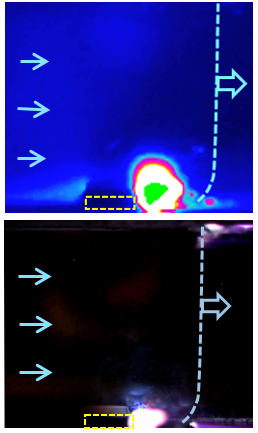
Evolution of thermal fields on a streamlined surface heated by a shock wave and plasma of a pulsed surface discharge


An experimental study was conducted to investigate the thermal fields in the boundary layer along the wall of a gas-dynamic channel near a rectangular insert. The study focused on conditions following the passage of a shock wave and during the initiation of a pulsed surface discharge in the flow. The heating and cooling dynamics of the region affected by the pulsed sliding discharge along the dielectric surface in the flow separation zone were examined. Registration of the radiation of the channel walls in the range of 1.5–5.1 µm was carried out through the side windows of the test (discharge) chamber of the shock tube, transparent both for the thermal radiation of the walls and for the visible radiation of the discharge. It is shown that the cooling of the insert region, heated by a localized nanosecond discharge in the leeward zone, occurs in less than a millisecond; on the shock-heated surface of the channel in the windward zone of the insert, cooling occurs in several milliseconds. The study measured radiative, conductive and convective components of heat fluxes in various supersonic flow configurations. The experiments were conducted in the range of shock wave Mach numbers M=2-4 and high-speed flows behind them, respectively, with Mach numbers M=1.1-1.4.

surface sliding discharge, plasma localization, thermal fields, infrared thermography, shock waves.


Volume 25, issue 6, 2024 year


Эволюция тепловых полей на обтекаемой поверхности, нагретой ударной волной и плазмой импульсного поверхностного разряда

Проведено экспериментальное исследование тепловых полей в пограничном слое на стенке газодинамического канала около прямоугольной вставки после прохода ударной волны и при инициировании импульсного приповерхностного разряда в потоке. Исследован процесс нагрева и остывания зоны локализации импульсного скользящего по поверхности диэлектрика разряда в области отрыва потока. Регистрация излучения стенок канала в диапазоне 1.5–5.1 µm велась через боковые окна рабочей (разрядной) камеры ударной трубы, прозрачные как для теплового излучения стенок, так и для видимого излучения разряда. Показано, что остывание нагретой локализованным наносекундным разрядом области вставки в подветренной зоне происходит за время менее миллисекунды; на ударно-нагретой поверхности канала в наветренной зоне перед вставкой остывание происходит за несколько миллисекунд. Регистрировались излучательная, теплопроводностная, конвективная составляющие тепловых потоков в различных конфигурациях сверхзвуковых течений. Эксперименты проведены в диапазоне чисел Маха ударных волн M=2-4 и высокоскоростных потоков за ними соответственно с числами Маха M=1.1-1.4.

поверхностный скользящий разряд, локализация плазмы, тепловые поля, инфра-красная термография, ударные волны


Volume 25, issue 6, 2024 year


1. Ju Y., Sun W. Plasma assisted combustion: Dynamics and chemistry // Progress in Energy and Combustion Science. 2015. V. 48. P. 21-83.
2. Bulat M., Denisenko B., et al. Plasma-assisted ignition and combustion of lean and rich air/fuel mixtures in low and high-speed flows // Acta Astronautica. 2020. V. 176. P. 700-709.
3. Shang J., Surzhikov S. Nonequilibrium radiative hypersonic flow simulation // Progress in Aer-ospace Sciences. 2012. V. 53. P. 46-65.
4. Brandis A., Johnson C., Cruden B. Non-equilibrium Radiation for Earth Entry // American In-stitute of Aeronautics and Astronautics. 2016.
5. Surzhikov S.T., Shuvalov M.P. Checking computation data on radiative and convectional heat-ing of next generation spacecraft // High Temperature. 2013. T. 51. P. 408-420.
6. Znamenskaya I., Lutsky A., Tatarenkova D., Karnozova E., Sysoev N. Nanosecond volume discharge in the non-stationary high-speed profiled channel flow // Physics of Fluids. 2023. V. 35. № 7.
7. Zuccher S., Saric W. Infrared thermography investigations in transitional supersonic boundary layers // Experiments in Fluids. 2008. V. 44. P. 145–157.
8. Frederick M., Banks D., et al. Flight tests of a supersonic natural laminar flow airfoil // Meas-urement Science and Technology. 2015. V. 26.
9. Goryainov V.Yu., Viktorov M.E., Vodop'yanov A.V., Voronin A.V. Peculiarities of the Dis-charge Formation in a Plasma Accelerator and Structure of a Jet Flowing into Vacuum // Tech-nical Physics. 2021. V. 66. P. 325-332.
10. Tirumala R., Benard N. et al. Temperature characterization of dielectric barrier discharge actua-tors: influence of electrical and geometric parameters // Journal of Physics D: Applied Physics. 2014. V. 47.
11. Znamenskaya I., Muratov M. et al. Heat fluxes visualization in high-speed flow behind the shock wave // Scientific Visualization. 2023. V. 15. № 3. P. 92-100.
12. Znamenskaya I.A., Koroteeva E.Yu., Karnozova E.A., Kuli-Zade T.A. Dynamics of Heat Fluxes in a Channel Area Heated by a Pulsed High-Current Discharge // High Temperature. 2023. V. 61. P. 14-18.
13. Mursenkova I., Znamenskaya I., Lutsky A.E. Influence of Shock Waves from Plasma Actua-tors on Transonic and Supersonic Airflow // Journal of Physics D: Applied Physics. 2018. V. 51.
14. Znamenskaya I., Tatarenkova D. et al. Nanosecond volume discharge in the non-stationary high-speed profiled channel flow // Physics of Fluids. 2023. V. 35.