Computational study of some classical molecular dynamics algorithms
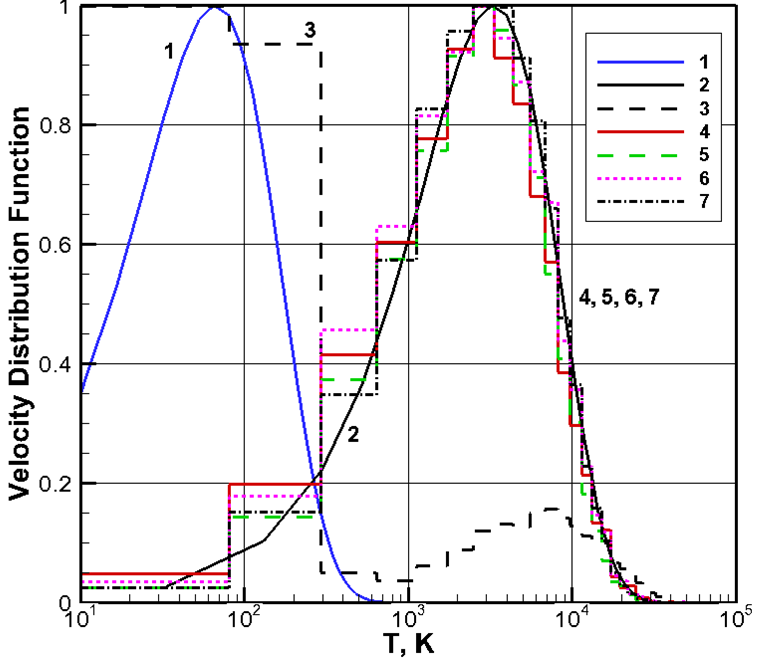
The paper presents the results of molecular dynamics modeling of the initial phase of thermalization of translational degrees of freedom of particles of a microcanonical en-semble with different initial velocity distributions. The Maxwellian initial distribution at a fixed temperature, an ensemble of particles at a constant velocity, and an equiprobable ve-locity distribution in a given range are considered. The problem of decay of an arbitrary discontinuity in a molecular dynamics cell is solved. The relaxation times of the initial ar-bitrary particle distribution to the steady-state Maxwellian distribution are determined in the temperature range K and pressures from 0.01 to 2 atm.
molecular dynamics method, microcanonical ensemble, thermalization of a statistical ensemble of structureless particles
Представлены результаты молекулярно-динамического моделирования началь-ной фазы термализации поступательных степеней свободы частиц микроканони-ческого ансамбля при задании различных исходных распределениях по скоро-стям. Рассмотрены максвелловское начальное распределение при фиксированной температуре, ансамбль частиц при постоянной скорости и при равновероятном распределении скоростей в заданном диапазоне. Решена задача о распаде произ-вольного разрыва в молекулярно-динамической ячейке. Определены времена ~ 10-9c релаксации исходного произвольного распределения частиц к установив-шемуся максвелловскому в диапазоне температур Т ~ 100 ÷ 10000 К и давлений от 0.01 до 2 атм.
метод молекулярной динамики, микроканонический ансамбль, термали-зация статистического ансамбля бесструктурных частиц
1. Хеерман Д. В. Методы компьютерного эксперимента в теоретической физике. М.: Физмат-лит. 1990. 175 с. 2. Frenkel D., Smit B. Understanding Molecular Simulation. Academic Press. 2002. 638 p. 3. Rapoport D. C. The art of molecular dynamics simulation. Cambridge University Press. 2004. 549 p. 4. Шноль Э. Э., Гривцов А. Г., Товбин Ю. К. и др. Метод молекулярной динамики в физиче-ской химии. М.: Наука. 1996. 336 с. 5. Методы компьютерного моделирования для исследования полимеров и биополимеров. Отв. Ред. Иванов В. А., Рабинович А. А., Хохлов А. Р. М.: Книжный дом «ЛИБРОКОМ». 2009. 696 с. 6. Гиббс Дж. В. Основные принципы статистической механики. М., Л.: Государственное из-дательство технико-теоретической литературы. 1946. 7. Баранов В.Б., Краснобаев К.В. Гидродинамическая теория космической плазмы. М.: Наука. 1977. 333 с. 8. Баранов В. Б. Гидроаэромеханика и введение в магнитную гидродинамику. М.: МГУ. 2018. 255 с. 9. Больцман Л. Лекции по теории газов. М., Государственное издательство технико-теоретической литературы. 1953. 10. Баранов В.Б. Газодинамические модели взаимодействия кометных атмосфер с солнечным ветром // Известия Российской академии наук. Механика жидкости и газа. 2023. № 1. C. 12-30. DOI: 10.31857/S0568528122700037 11. Ступоченко Е. В., Лосев С. А., Осипов А. И. Релаксационные процессы в ударных волнах. М.: Наука. 1965. 454 с. 12. Kantor A. L., Long L. N., Micci M. M. Molecular Dynamics Simulation of Dissociation Kinetics // Journal of Thermophysics and Heat Transfer. 2001. Vol. 15. No. 4, p. 478. 13. Котов Д. В., Суржиков С. Т. Моделирование скорости диссоциации и времени колебатель-ной релаксации двухатомных молекул методом молекулярной динамики // Теплофизика высоких температур. 2008. Т. 46. № 5. 14. Ландау Л. Д., Лифшиц Е. М. Теоретическая физика Т.1. Механика. М.: Наука» 1965. 204 с. 15. Зельдович Я. Б., Райзер Ю. П. Физика ударных волн и высокотемпературных гидродина-мических явлений. М.: Наука. Гл. редакция физико-математической литературы. 1966. 686 с. 16. Ландау Л. Д., Лифшиц Е. М. Теоретическая физика Т.V. Статистическая физика. Часть 1. М.: «Наука» 1976. 583 с. 17. Surzhikov S. T. Application of Quasistationary eRC-Models for Calculating Nonequilibrium Ra-diation of Shock Waves at Velocities of Approximately 10 km/s // Fluid Dynamics. 2022. Vol. 57. Suppl. 2, pp. S594–S621. 18. Суржиков С. Т. Модель усредненной по вращательной структуре неравновесной излуча-тельной способности двухатомных молекул // Физико-химическая кинетика в газовой ди-намике. 2023. Т.24, вып. 6. http://chemphys.edu.ru/issues/2023-24-6/articles/1078/ 19. Кусов А. Л., Быкова Н. Г., Герасимов Г. Я., Забелинский И. Е., Козлов П. В., Левашов В. Ю. Численное исследование излучения в ударно-нагретой смеси CO2 и N2 методом прямого статистического моделирования // Изв. РАН. МЖГ. 2023. № 6. С. 192-204. 20. Kozlov P. V., Zabelinskii I. E., Bykova N. G., et al. Radiation Characteristics of Shock-Heated Air in the Visible and Infrared Spectral Ranges // Fluid Dyn. 2023. Vol. 58. Pp. 960–967. https://doi.org/10.1134/S0015462823601328 21. Smekhov G. D., Sergievskaya A. L., Pogosbekian M. Y., et al. Level Adiabatic Model for the Dissociation of Diatomic Molecules // Fluid Dyn. 2023. Vol. 58. Pp. 796–810. https://doi.org/10.1134/S0015462823601079 22. Шноль Э. Э. Численные эксперименты с движущимися молекулами // В кн. Метод молеку-лярной динамики в физической химии. М.: Наука. 1996. С.109-127.